A Clipping From Time

On March 6, 2020, after laying his father to rest, the author received a family Bible from his dad’s cousin Beverly. This Bible, a cherished family heirloom, contained a receipt and a clipping of the song “The Song of a Tired Servant” by Anna Bartlett Warner. The discovery linked her family’s history with profound blessings of faith.

The Hands and Heart of an Ancestor

Some days stand out from the others. On March 6, 2020, we laid my dad’s body to rest. After his funeral service, dad’s first cousin Beverly presented me with a family treasure. She said, since you are our family historian, you should have it. I was shocked at her generosity and thoughtfulness.

Beverly handed me a beautiful custom-made box containing the family Bible which belonged to Beverly and Dad’s great-grandfather and my great-great-grandfather, James Monroe Culpepper of Harris County, Ga. This Bible, printed in 1859, was one hundred eighty years old on that day. Today, we can add five years to that. Dad had revered this family Bible and spoke of it often. This Bible contains much of our family history.

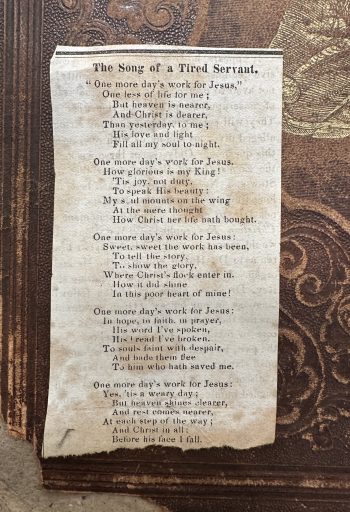
This week, while preparing for a Culpepper family gathering in June to honor our grandparent’s 100th wedding anniversary, I searched this cherished Bible and found two items I had never noticed. One was a receipt from when my great-great-grandmother Frances Culpepper had made a purchase, and it had her name written on it and from whom the items were purchased. Some items purchased on the receipt were tea, coffee, buttons, etc. The second item found was a clipping from a newspaper of a song entitled “The Song of a Tired Servant.” The clipping is so tiny and can easily be overlooked.

This song touched my ancestor’s heart so much that their hands were moved to clip it and place it in the family’s treasured Bible. I began researching the song and found the author to be famous. Not so much for this song, but it is one most of us know and have memorized. The most famous song lyrics Anna Bartlett Warner wrote (1827-1915) is “Jesus Loves Me.” How often have I sung this powerful song knowing little to nothing about its writer? Anna’s sister, Susan Bogert Warner (1819-1885), is just as famous for her literary works.

Back to the clipping. This song focuses on the blessings and buffetings of following Christ as a disciple. Here are the words…

The Song of the Tired Servant

“One more day’s work for Jesus, one less of life for me; But heaven is nearer, and Christ is dearer than yesterday to me; 

His love and light fill all my soul tonight.

One more day’s work for Jesus. How glorious is my King! Tis joy, not duty, to speak His beauty. 

My soul mounts on the wing, at the mere thought how Christ her life hath bought.

One more day’s work for Jesus; Sweet, sweet the work has been, to tell the story to show the glory, Where Christ’s flock enter in.

 How it did shine in this poor heart of mine.

One more day’s work for Jesus in hope, in faith in prayer 

His Word I have spoken His bread I have broken. 

To souls faint with despair and bade them flee, to Him who hath saved me

One more day’s work for Jesus, yes, tis a weary day, but heaven shines clearer, and rest comes nearer.

 At each step of the way and Christ in all, before His face, I fall.”

I will not elaborate on the words of this song as they powerfully speak for themselves. I agree with the author, and her words are true. But what of the fortunate timing of my discovery? As the author’s words are true to me, the same words were true almost two centuries ago when my ancestor held this tiny clipping and placed it away where all truth abounds, the Word of God. 

It’s as if my great-great-grandmother or grandfather, without knowing, handed me a note of inspiration—a note from their hand to mine containing words that blessed and encouraged them, words they wanted to see again, so they tucked it away for future reference. I doubt they realized how far into the future that would be.

After years of following Christ, however imperfectly, I’ve learned not to believe in coincidences but in the flawless timing of my perfect Savior…

Innings of Life

On March 2, 2020, Grandaddy Perry passed away after a prolonged battle with Alzheimer’s disease. His legacy of love, faith, and life lessons endures in his family. Memories of shared moments, wisdom imparted on baseball and music, and unconditional support shape those he left behind, ensuring his spirit remains alive in them.

Guest Post By Alex Culpepper

On a quiet early morning  March 2, 2020, Grandaddy Perry took his final breath. It was in the same house where he had spent so many years shaping my life and the lives of those who loved him. The funeral home workers arrived in the early morning hours with a bag of supplies and the dreaded stretcher that would strip us of his presence. 

The weight of the moment settled heavy in the dining room as they went to carefully retrieve his body. The absence of his presence weighed heavy on our hearts, but even more, we felt a cloud of grief as we reflected on his long, painful journey with Alzheimer’s disease. A disease that slowly stole pieces of him for five years leading up to that morning.

Grandaddy’s Alzheimer’s wasn’t a sudden occurrence. It began gradually, almost unnoticed. At first, there were little things, like misplaced glasses, incomplete tasks, or failing to recall a phone number he had dialed many times before. We would often laugh it off, saying, “He’s just forgetful,” or “He’s getting older.” But even in those early days, I noticed how he would repeat the same joke saying, “If pork is so unhealthy why don’t pigs get sick?” 

Concern began to grow as he would quietly ask Mamaw the names of people he had known his entire life. We watched as all the small things began to add up, and little by little the disease stole the resolute man that was once so full of life. As the workers moved slowly past us, wheeling his earthly body down the hallway, memories began flooding my mind triggering many moments of love, laughter, and wisdom that I would carry with me forever. Grandaddy played a vital role in shaping me into the man I am today. His love for the Lord, our family, baseball, and song-writing brought lessons that I will carry with me for the rest of my life. 

Grandaddy’s home, affectionately called “Mamaw’s House”, had always been the center of my childhood. It was a sanctuary where I found comfort and the rhythm of everyday life. You could find my brother and I there every afternoon after school and nearly every summer weekday. Grandaddy’s presence was extensive on those familiar five acres. The pride he had for his property was evident in the time he dedicated to making sure it remained the refuge we all loved so deeply.

I can still picture the 1958 Ford tractor he drove in the hot summer heat to cut the fields surrounding the house. It’s rusted yellow bush-hog PTO attachment hummed with steady force as the rhythmic sound of turning blades filled the air. I can hear the growl of the tired engine echoing across the yard as it met the earth with a purpose. There was Grandaddy riding high, perched on the seat in his faded blue jeans, tattered flannel, and worn baseball cap. 

Some days he would pick me up from school in his sunburnt blue 1980’s Dodge van, with its well-worn cloth bench seats and lap seatbelts. The van always had a musty odor mixed with faint gasoline fumes. I never told him how nauseous I felt in the backseat, as the swaying ride and gasoline smell stirred my stomach. He must have known, but I never complained. As he focused on the journey ahead, he would whistle an unrecognizable tune through his teeth.

It was in those unremarkable drives that I learned how to handle some of life’s discomforts without making a fuss. Grandaddy never hurried or voiced a complaint. His life flowed like a steady stream focused on what mattered most, his faith, family, and being honorable in all things.

Grandaddy’s love for baseball came alive in the back fields behind Mamaw’s House.  The afternoon sun would cast long shadows from the Georgia pines as he geared up to practice. He would grab his worn-out leather glove, baseball, and bat eagerly as he led me and my brother outside to play. Baseball wasn’t just a game to him, it was a language, a way of life, a bond that tied the two us together. Our ballfield was barely an acre in size, complete with a makeshift plywood backstop held up by an old mini refrigerator. 

As we honed our skills and strived to achieve his expectations, Grandaddy’s wisdom was unknowingly being poured into us. I can still hear his voice across the ballfield, “If you touch it, you catch it!” At the time, I didn’t realize how much those words would mean to me later in life. I’ve come to know that his words weren’t just about baseball. It was a phrase that had implications for all areas of life. This steady mantra grew beyond baseball, and became more about being present, committed, and having the courage to face whatever may come my way. Even when the baseball would come fast or bounced unpredictably off the ground, I had to believe that I could catch it and fully commit to facing the oncoming challenge.

He applied the “You touch it, you catch it” philosophy in all areas of his life. It was fully embodied in the condition of his wedding ring. What had once been a flawless solid gold band,was now bent and mangled from years of catching pop flies and line drives or working on his tractor. It was a testament of his love for his wife and dedication to the life they built together. Every dent and bend showed his determination to be the man he promised her he would be. The ring, like him, had seen so much life, from the highest mountain tops to the deepest valleys and everything in-between. It represented a life lived to the fullest, a life well lived and a love that endured until he took his last breath. 

On the occasions that Grandaddy was not on the tractor or throwing the baseball around, he would sit with his acoustic guitar in hand. I remember the way he would attack the strings as he forcefully strummed his guitar. His playing of familiar songs and hymns would fill the air of the living room with sweet sounds and a warm tones. He was a gifted songwriter. His songs were unique, clever, and often inspired by true stories. His hands would hug the guitar’s neck with ease, mimicking the melodies of his 1950’s youth. My fingers small and uncoordinated, struggled to form the right chord positions on the neck. 

Grandaddy never rushed me or showed an ounce of frustration. Instead, he was patient and told me, “You’ll never be a true guitar player until you learn how to play the Wildwood Flower.” A sacred country-western song made famous by the Carter family. I didn’t fully understand then, but now I realize he was teaching me more than just how to play a song. He was teaching me that dedication and mastery, in music only comes through discipline, patience, and practice.

Grandaddy also instilled the values of deep faith within me. His relationship with Jesus was not a weekend activity, but the bedrock of his life. It was something that was lived out daily in his actions, words, and treatment of people. I can still see him sitting in his favorite spot on the grey sectional couch with his Bible open in his lap and his cracked weathered hands resting gently on the pages. His beloved Bible had been worn from years of faithful use, and were key to his relationship Jesus. He would study each verse with precision and care, treasuring it deep in his heart. His faithful love for Jesus and the example he modeled helped me establish the foundation for my own relationship with Christ. 

Grandaddy and Mamaw’s House was more than just a place to stay, it was where I learned to be kind, to be patient, and to love fully. The orange shag carpet in the living room, the smell of Mamaw’s cooking drifting from the kitchen, and the voice of Skip Caray announcing the play-by-play action of the Braves game playing on the woodgrain tv in the living room were all interwoven pieces of the tapestry of my memories. 

I felt deep emptiness as my father, mother, brother and I stood in the dining room and watched the funeral home workers wheel Grandaddy out the back door one last time on that early March morning. I couldn’t help but wonder, was it this familiar red-brick home with the washed-out gravel driveway that held the memories? 

As time has passed, I have learned that my memories aren’t contained in the house, but they are in the moments spent with him. The lessons learned and the wisdom acquired, all remain with me even though I do not walk down the hallways or run in the fields anymore. I still hear his words in my mind, cheering me on from the sidelines, offering support when I need it most. 

Grandaddy Perry may have physically left this world on March 2, 2020, but every day he lives on, in, and through me. He is in the guitar I play every week as I lead worship, in the Bible verses I read daily, and in the way I navigate life. When I slip on my leather baseball glove, ready for the ball to come, I hear him once again call out “If you touch it, you catch it!” 

I find comfort in the thought that perhaps in Heaven, there is a softball league where Grandaddy is wearing a number eighteen jersey playing the game he loved in the presence of our Savior. And when my time comes in death or rapture, I know we’ll pick up right where we left off laughing, living, and worshipping together on that heavenly shore. Until that day comes, I carry Grandaddy with me. I know that each lesson he taught me will never fade but will be carried on by my daughters who share his last name.

Though Grandaddy may be gone from this world, he will never truly leave because of the pieces of his life he gave. Still quietly guiding me through the innings of life…

6
Off to the Country Store

Visiting my grandmother’s home in South Georgia during the 1970s felt like a step back in time. Without modern conveniences, we enjoyed simple pleasures, like trips to the country store for candy and Cokes. These memories of childhood adventure, exploring nature, and the iconic store remain cherished, symbolizing a simpler, joyous era.

Visiting my grandmother’s home in South Georgia in the early 1970s was like going back twenty or thirty years. Many of the things commonplace in our homes today were absent. There was no air conditioning but plenty of fans humming. There was no indoor bathroom. There was an indoor bathroom, but the plumbing wasn’t connected, so we continued walking to the “outhouse.” For some reason, the plants around the outhouse grew green and tall.

Corn fields surrounded Grandmother’s house. My slightly older aunt and I would take my younger sister into the middle of the cornfield and leave her to find her way out. Once my sister was “planted,” my aunt and I would return to our front porch perch and watch the corn stalks move around until my sister began to cry. Looking back, that was mean of my aunt to do that. 

Our schedule was discussed each day. But, if we weren’t careful, Grandmother would have us shelling peas or shucking corn. On a good day, we would find ourselves walking to the country store, and these trips could be more exciting than one may expect. 

We could spend several hours making the round-trip trek to Tarpley’s Store. Most rural communities in South Georgia had a small country store with necessities of life. For a child, bread, milk, and eggs were not necessities. Our necessities were candy and Cokes. 

As we made our way, we would ask each other, “What kind of ‘Coke” will you get?” In the South, every soft drink was called a “Coke,” whether from a bottle or later a can. To us, Dr. Pepper was a kind of “Coke,” as was Sprite, and so on. We had plenty of time to choose our “Coke” as we walked.

During those days, country dirt roads were lined with plentiful plum trees and prickly blackberry bushes. Our task was to pick as many plums or blackberries as possible, depending on the season. If we cupped our shirts just right, we could pick a bunch. Our tummies taught us at an early age to only eat the ripe ones. 

Another part of the mission was to pick up as many “Coke” bottles as possible along the side of the road and return them for money. The part I left out, we would often begin our trip with no money, so the “Coke” bottle return was important. No bottles, no “Coke” and candy! Another problem was that the younger children didn’t find many bottles because they weren’t fast enough. So, we had to work out our version of asset redistribution.

Once we arrived at our destination, we proudly presented the storekeeper with the bottles we found and received our fortune. Only then did we know what delicious treats we could afford? The goal: everyone gets a “Coke” and some candy. Nehi grape or orange “Coke” was always at the top of the list of drink choices, and most of the candy was one cent a piece. Today, one 12 oz. Nehi grape drink will cost three dollars! I checked.

When our “business” was finished, we began our journey back. As we walked and talked (I can’t remember what we talked about), we sipped our drinks, ate our candy, and picked a few more plums and blackberries to my grandmother’s house.

Several times during our 43 years together, I’ve tried to show my wife the location of that exceptional place, Tarpley’s store. This iconic landmark from my childhood is long gone, but in my mind, it’s still standing and open for business. I can see the rusty tin roof and the white siding; I can walk up to the screen door with the Sunbeam Bread logo and go inside.  Everything is in its place—the long row of candy and the “Coke” box cooler under the front window. For me, because it once was, it will always be…in my mind. 

I sometimes yearn for simpler times when the biggest decision was, “What kind of Coke do I want today?”

Have You Seen Mary

Sarah, curious about her mother Mary’s mysterious family, finds a trunk after her mother’s passing. Inside, she discovers her mother’s hidden past, including a scandal that led to her disownment. Corresponding with her great-uncle Charles, Sarah learns about her family’s history and the truth behind her mother’s silence.

Sarah is now opening a trunk in her mother’s closet, which she had seen before, and often asked, “What’s in the truck, mother?” “Oh, nothing important,” her mother would reply or say something similar. Today is different. Mom has passed away and is not here for her to ask once again, “What’s in the truck?” She thought, “If it wasn’t important, why did her mother keep it all these years? “ 

Sarah’s mother, Mary, was an open book about her life except for one thing: her family. Only in passing did she share stories from her childhood, but only mentioning her mother, brothers, and sister. Sarah knew little about her mother’s “people.” In the South, we often refer to our family and close friends as “our people.”

As she grew older, Sarah became curious about her mother’s “people” but learned not to bring up the subject. She left the “mystery trunk” to last as she went through her mother’s things. Now that her mom was not here to say no, Sarah cautiously opened the truck, not knowing what she would find.

The hinges on the old trunk creaked as Sarah lifted its lid. She found some legal documents, her parent’s marriage license, and other things. Then she noticed a small box containing pictures that looked like her mother as a child, but she wasn’t sure. A few photos of a family that she didn’t recognize. However, written on the back of one photo was “my younger brothers Rev. Charlie, Ab, and Mercer.” Sarah thought, “Who’s younger brothers?”

She dug further into her mother’s past and saw an envelope named Uncle Charles and a return address. Sarah laid the envelope aside and kept digging. One day, she got the courage to write to Reverend Uncle Charlie. To her surprise, Uncle Charlie responded with a letter: “Hello, Mary. I’m so glad you wrote. I am your great-uncle Charles, a Baptist pastor and a younger brother of your grandfather Sam.” (Sam and Charlie were two of seventeen siblings.)

In the months ahead, Sarah and great-uncle Charles corresponded. She learned family stories and names she had never heard. The one big question for Sarah was, “Why did mother never mention ‘her people’?” She would soon have her answer.

Sarah’s mother, Mary, was the oldest daughter of Sam and Mary Ella. Sam married his sweetheart on December 31, 1882. Soon came two sons and a beautiful baby girl, Mary, named after her mother. Mary’s young life was typical for a family in the reconstruction of the South, that is, until age 16. Mary found herself with child and not married. 

The reputation of many Southern families would rise or crumble according to strict adherence to society’s expectations.  Mary mustered the nerve to tell her mom and dad about her “situation.” Back then, when a family had a “situation,” the young lady would go “visit family” just far enough away for the news to not reach home, and after nine months or so, she would return. While her mother’s face displayed disappointment, her dad was so furious that he threw her out of their home, hoping to save the family’s reputation.

As the anger of Mary’s father (the Reverend Sam) lessened, he expected her to return home, but she never did. Month after month, Sam and Mary Ella waited. Sam became desperate to find his oldest daughter, so he changed jobs and was hired by a railroad company as a food “butcher boy.” (In the 1880s, the U.S. colloquialism Butcher and Butcher Boy referred to a vendor of candy, fruit, sandwiches, newspapers, etc., on street corners and trains, at sporting events, etc.)

This new job on the trains allowed him to repeat the question in every train car and depot: “Have you seen Mary?” For years, he traveled and asked that question. Sadly, Sam and Mary Ella’s marriage could not withstand the stress of how Sam handled the “situation” with their daughter, and they divorced in 1915.

As their letters continued, great Uncle Charles would tell Sarah more about her grandfather’s “people.”  Charles contacted his brother Sam and told him about his granddaughter, but no one knew if Sarah and Sam ever met. Sarah’s grandmother, Mary Ella, died in 1935 and was buried with her “people.” Sarah’s grandfather, Rev. Samuel Bartley Culpepper (my great-grandfather Mercer’s older brother), died in 1941 at 83, probably still asking, “Has anyone seen Mary?”

Old Shoes

The author reminisces about a pair of worn-out shoes, reflecting on their shared journey over the years. Despite their age, the shoes symbolize significant life moments, from church sermons to global travels and family events. Ultimately, the writer grapples with the bittersweet decision to discard them, underscoring the emotional bond formed through shared experiences.

Last week, I made an ordinary walk to our outdoor garbage can. In my hands, I held a pair of overly worn-out dress shoes. On the surface, there was nothing special about these shoes. As I walked towards the large bin reserved for things no longer considered of value, I was struck by their connection to me. 

I remember the day I purchased these shoes at a local shoe store. My new pair must be perfect. As a creature of habit, if I find something I like or, more importantly, something that fits me, I tend to stick with it, creating a long, close relationship. These shoes would be with me for a long, long time. 

The first day I wore these shoes was the following Sunday. As I walked on the tile floor at church, I slipped and almost fell, creating excitement for everyone who saw me. “Are you alright, preacher?” “Oh yes,” I said. I’m wearing new shoes. I walked to the parking lot and did my best to scuff up the leather soles to help me with traction as I walked to greet my friends and church family. From that day, few others would notice these simple, nondescript wingtip black Oxford shoes, but they were special to me and reserved for only the special days.

As I dropped these shoes into the can, they hit the bottom of the vacant bin with an echoing thud. The garbage can was empty, and they were the first residents of the can this week. I looked into the can and asked myself, “Am I going to throw these away? These shoes are unique; we’ve been on a long journey together.”

As I turned to return to our home, a streak of emotion hit me; I looked around to see if anyone could see my tear or two. Continuing my solemn walk, I was relieved that only these shoes caught the instant emotion. Once inside, I sat in “my chair” for every Southern gentleman has a chair reserved for him and him alone (except for granddaughters and a grandson who can sit there anytime they want.)

Sitting in my sacred chair, I wondered where the emotion came from because these shoes were old and worn out; their time was finished. I began to reflect on the first Sunday I wore them and the entertainment they brought. Then I thought about the hundreds of sermons God had allowed me to preach wearing these shoes, mostly in my home church, but then I remembered all the places these shoes and I had journeyed together. These shoes have traveled with me to Russia, Poland, Moldova, Ireland, Jamaica, Haiti, India, and other places. They had traveled the world with me. 

I have worn these shoes in almost every funeral home within one hundred miles and beyond. They were with me as I trekked through mountain cemeteries and backwoods family funeral plots. They were with me in one local cemetery more than one hundred times. 

I wore these shoes for the marriage ceremonies for my two precious sons and new daughters along with many other weddings. I wore them at the graveside of my dearest father and father-in-law.

The garbage truck would come and take them away in a few days. It brought a small comfort that I had until Thursday to decide. As I sat, I asked myself, “Are you going to throw these special shoes away?” To add to the misery, whenever I walked outside, I was reminded that my special shoes sat at the bottom of the trash can and awaited their fate. I didn’t mention that once I removed these shoes from our closet, I placed them in the corner of our bedroom, where they rested for weeks. (After many years together, my sweet wife was aware of the slow journey of releasing anything special to me, so she let them sit.)

Thursday came and went; I heard the garbage truck load our cans and drive away. The decision was final, or was it? The truck was not far away, and I knew I could find my friends now missed with all the other special things others had thrown away. 

At that moment, I realized they were gone, never to be seen again. The decision I made could not be reversed. Is it normal to think so much about an old pair of shoes? I told my wife of the struggle during the last few days. Life has taught me that I can only talk to two: God and my partner for life. She sweetly reaffirmed that I was somewhat sane and that my feelings were normal. 

A few days before my friends would leave, I traveled to a local shoe store looking for a particular pair of shoes. Maybe I could find some just like my old friends, but they were not to be found. The new shoes looked similar but would always be different from my old friends. My old friends wore the scars of our friendship, of our long journey together. As I write, I think, “Where could my old friends be?”

But what of my new friends? Where will we travel together? What story will they have to tell? Hello, my new friends. We have some places to go…