1787: A Georgia Pioneer Christmas

In the early 1780s, William Culpepper, a Revolutionary War patriot, moved with his family from North Carolina to Georgia, establishing their new life. By 1787, they became charter members of Williams Creek Baptist Church, celebrating Christmas amidst pioneer simplicity. Today, descendants cherish their legacy and the church’s ongoing tradition.

When most settlers migrated from North and South Carolina to Georgia, they took along whatever they needed to start their new lives. In a caravan of wagons, they would bring their cows for milk, hogs, chickens, and geese for mattresses and pillows. Some animals were caged, when possible, but the larger animals were herded along the dirt road or path. By the mid 1780’s, William’s family would have built a log home with wood shingles and begun their new life in Georgia.

A few years after they arrived in Georgia and three days before Christmas, on December 22, 1787, William and his wife became charter members of the Church at Williams Creek in Warren County, Georgia (today known as Williams Creek Baptist Church). This would have been the church’s first Christmas service.

What songs would have been sung that day? Many of the Christmas Carols we sing today (O Little Town of Bethlehem, O Holy Night) were not yet written until the early to middle 1800’s. But there were some carols we love to sing today that became popular in the Middle to late 1700’s. Charles Wesley had written “Hark the Herald Angels Sing” in 1739. Wesley wrote the song in celebration of his new commitment as a Christ follower. The original first line was “Hark the Herald the Welkin (heaven) Sing”. In 1753, George Whitfield, the great preacher and friend of Wesley, changed the first line to what we sing today, “Hark the Herald Angels Sing.” Issac Watts wrote “Joy to the World” in 1719 and was popular towards the end of the 1700’s. The hymn “Amazing Grace” was about 10 years old at the time. Oh, to be a part of the church service that day.

Christmas Day was a few days later, and by this time, William’s children were young adults, and some were married. The matriarch of the family would have led in preparing a simple Christmas meal, cooking it over the open flame and embers in their home’s large fireplace. William or one of his sons would have hunted and killed a wild bird, and if none were found, one or two chickens would have been the main course. To complete the meal, she would have cooked dry beans or possibly green beans, maybe an apple pie (cooked in a Dutch oven, by the fireplace), and bread. Christmas gifts were not a consideration as the family would have been content with the company of their family, an excellent meal, and maybe a part of the day off from their labors. Such was Christmas in pioneer East Georgia in 1787.

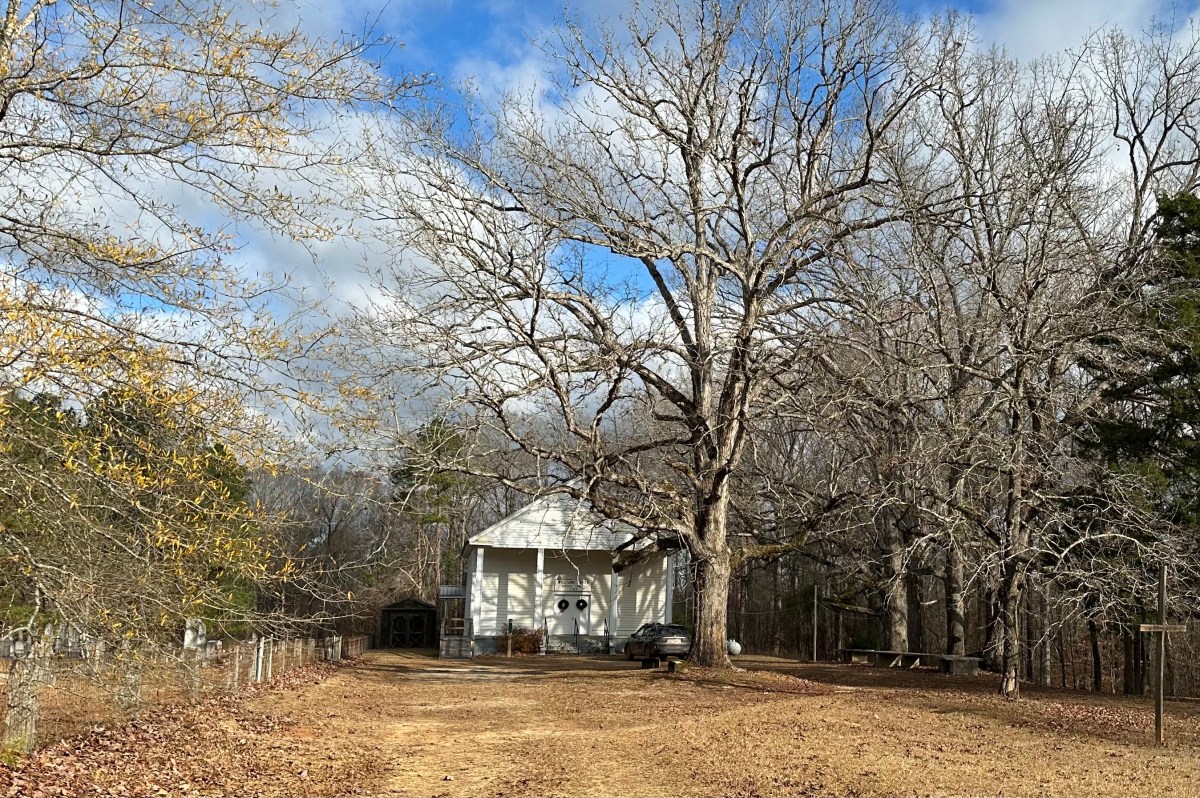
Several months ago, Kim and I joined that same Williams Creek Baptist Church. The church still meets on the same property where my grandparents worshiped; the only difference is that we meet in the “new” sanctuary built in 1840. Some of my Culpepper ancestors are buried in marked graves in the cemetery next to the “new building.” I’m convinced that William and his son Daniel Culpepper, along with their families, are buried in the “old cemetery” down the hill in the woods beside Williams Creek. Their graves were probably once marked by field stones or simple wooden crosses, but have now been reclaimed by the nature that the little Boy in the manger created. 

This past Sunday, I was honored to play the piano and lead the music for our Christmas Service, marking the 238 years of Christmas services at Williams Creek. Our small congregation shared an excellent Christmas meal after the service because Baptists like to eat.

I look forward to meeting ancestors one day and having a good chat. So, from a grateful great-grandson of two Revolutionary War patriots and Georgia pioneers… Merry Christmas!
A Clipping From Time

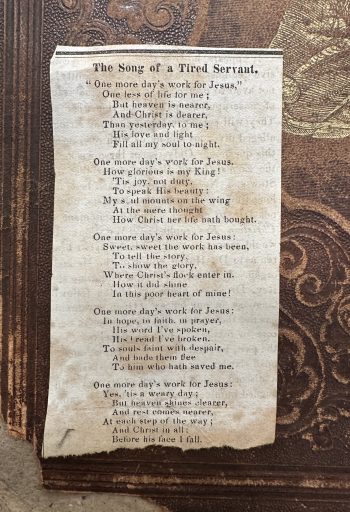
On March 6, 2020, after laying his father to rest, the author received a family Bible from his dad’s cousin Beverly. This Bible, a cherished family heirloom, contained a receipt and a clipping of the song “The Song of a Tired Servant” by Anna Bartlett Warner. The discovery linked her family’s history with profound blessings of faith.

The Hands and Heart of an Ancestor

Some days stand out from the others. On March 6, 2020, we laid my dad’s body to rest. After his funeral service, dad’s first cousin Beverly presented me with a family treasure. She said, since you are our family historian, you should have it. I was shocked at her generosity and thoughtfulness.

Beverly handed me a beautiful custom-made box containing the family Bible which belonged to Beverly and Dad’s great-grandfather and my great-great-grandfather, James Monroe Culpepper of Harris County, Ga. This Bible, printed in 1859, was one hundred eighty years old on that day. Today, we can add five years to that. Dad had revered this family Bible and spoke of it often. This Bible contains much of our family history.

This week, while preparing for a Culpepper family gathering in June to honor our grandparent’s 100th wedding anniversary, I searched this cherished Bible and found two items I had never noticed. One was a receipt from when my great-great-grandmother Frances Culpepper had made a purchase, and it had her name written on it and from whom the items were purchased. Some items purchased on the receipt were tea, coffee, buttons, etc. The second item found was a clipping from a newspaper of a song entitled “The Song of a Tired Servant.” The clipping is so tiny and can easily be overlooked.

This song touched my ancestor’s heart so much that their hands were moved to clip it and place it in the family’s treasured Bible. I began researching the song and found the author to be famous. Not so much for this song, but it is one most of us know and have memorized. The most famous song lyrics Anna Bartlett Warner wrote (1827-1915) is “Jesus Loves Me.” How often have I sung this powerful song knowing little to nothing about its writer? Anna’s sister, Susan Bogert Warner (1819-1885), is just as famous for her literary works.

Back to the clipping. This song focuses on the blessings and buffetings of following Christ as a disciple. Here are the words…

The Song of the Tired Servant

“One more day’s work for Jesus, one less of life for me; But heaven is nearer, and Christ is dearer than yesterday to me; 

His love and light fill all my soul tonight.

One more day’s work for Jesus. How glorious is my King! Tis joy, not duty, to speak His beauty. 

My soul mounts on the wing, at the mere thought how Christ her life hath bought.

One more day’s work for Jesus; Sweet, sweet the work has been, to tell the story to show the glory, Where Christ’s flock enter in.

 How it did shine in this poor heart of mine.

One more day’s work for Jesus in hope, in faith in prayer 

His Word I have spoken His bread I have broken. 

To souls faint with despair and bade them flee, to Him who hath saved me

One more day’s work for Jesus, yes, tis a weary day, but heaven shines clearer, and rest comes nearer.

 At each step of the way and Christ in all, before His face, I fall.”

I will not elaborate on the words of this song as they powerfully speak for themselves. I agree with the author, and her words are true. But what of the fortunate timing of my discovery? As the author’s words are true to me, the same words were true almost two centuries ago when my ancestor held this tiny clipping and placed it away where all truth abounds, the Word of God. 

It’s as if my great-great-grandmother or grandfather, without knowing, handed me a note of inspiration—a note from their hand to mine containing words that blessed and encouraged them, words they wanted to see again, so they tucked it away for future reference. I doubt they realized how far into the future that would be.

After years of following Christ, however imperfectly, I’ve learned not to believe in coincidences but in the flawless timing of my perfect Savior…

Off to the Country Store

Visiting my grandmother’s home in South Georgia during the 1970s felt like a step back in time. Without modern conveniences, we enjoyed simple pleasures, like trips to the country store for candy and Cokes. These memories of childhood adventure, exploring nature, and the iconic store remain cherished, symbolizing a simpler, joyous era.

Visiting my grandmother’s home in South Georgia in the early 1970s was like going back twenty or thirty years. Many of the things commonplace in our homes today were absent. There was no air conditioning but plenty of fans humming. There was no indoor bathroom. There was an indoor bathroom, but the plumbing wasn’t connected, so we continued walking to the “outhouse.” For some reason, the plants around the outhouse grew green and tall.

Corn fields surrounded Grandmother’s house. My slightly older aunt and I would take my younger sister into the middle of the cornfield and leave her to find her way out. Once my sister was “planted,” my aunt and I would return to our front porch perch and watch the corn stalks move around until my sister began to cry. Looking back, that was mean of my aunt to do that. 

Our schedule was discussed each day. But, if we weren’t careful, Grandmother would have us shelling peas or shucking corn. On a good day, we would find ourselves walking to the country store, and these trips could be more exciting than one may expect. 

We could spend several hours making the round-trip trek to Tarpley’s Store. Most rural communities in South Georgia had a small country store with necessities of life. For a child, bread, milk, and eggs were not necessities. Our necessities were candy and Cokes. 

As we made our way, we would ask each other, “What kind of ‘Coke” will you get?” In the South, every soft drink was called a “Coke,” whether from a bottle or later a can. To us, Dr. Pepper was a kind of “Coke,” as was Sprite, and so on. We had plenty of time to choose our “Coke” as we walked.

During those days, country dirt roads were lined with plentiful plum trees and prickly blackberry bushes. Our task was to pick as many plums or blackberries as possible, depending on the season. If we cupped our shirts just right, we could pick a bunch. Our tummies taught us at an early age to only eat the ripe ones. 

Another part of the mission was to pick up as many “Coke” bottles as possible along the side of the road and return them for money. The part I left out, we would often begin our trip with no money, so the “Coke” bottle return was important. No bottles, no “Coke” and candy! Another problem was that the younger children didn’t find many bottles because they weren’t fast enough. So, we had to work out our version of asset redistribution.

Once we arrived at our destination, we proudly presented the storekeeper with the bottles we found and received our fortune. Only then did we know what delicious treats we could afford? The goal: everyone gets a “Coke” and some candy. Nehi grape or orange “Coke” was always at the top of the list of drink choices, and most of the candy was one cent a piece. Today, one 12 oz. Nehi grape drink will cost three dollars! I checked.

When our “business” was finished, we began our journey back. As we walked and talked (I can’t remember what we talked about), we sipped our drinks, ate our candy, and picked a few more plums and blackberries to my grandmother’s house.

Several times during our 43 years together, I’ve tried to show my wife the location of that exceptional place, Tarpley’s store. This iconic landmark from my childhood is long gone, but in my mind, it’s still standing and open for business. I can see the rusty tin roof and the white siding; I can walk up to the screen door with the Sunbeam Bread logo and go inside.  Everything is in its place—the long row of candy and the “Coke” box cooler under the front window. For me, because it once was, it will always be…in my mind. 

I sometimes yearn for simpler times when the biggest decision was, “What kind of Coke do I want today?”

Have You Seen Mary

Sarah, curious about her mother Mary’s mysterious family, finds a trunk after her mother’s passing. Inside, she discovers her mother’s hidden past, including a scandal that led to her disownment. Corresponding with her great-uncle Charles, Sarah learns about her family’s history and the truth behind her mother’s silence.

Sarah is now opening a trunk in her mother’s closet, which she had seen before, and often asked, “What’s in the truck, mother?” “Oh, nothing important,” her mother would reply or say something similar. Today is different. Mom has passed away and is not here for her to ask once again, “What’s in the truck?” She thought, “If it wasn’t important, why did her mother keep it all these years? “ 

Sarah’s mother, Mary, was an open book about her life except for one thing: her family. Only in passing did she share stories from her childhood, but only mentioning her mother, brothers, and sister. Sarah knew little about her mother’s “people.” In the South, we often refer to our family and close friends as “our people.”

As she grew older, Sarah became curious about her mother’s “people” but learned not to bring up the subject. She left the “mystery trunk” to last as she went through her mother’s things. Now that her mom was not here to say no, Sarah cautiously opened the truck, not knowing what she would find.

The hinges on the old trunk creaked as Sarah lifted its lid. She found some legal documents, her parent’s marriage license, and other things. Then she noticed a small box containing pictures that looked like her mother as a child, but she wasn’t sure. A few photos of a family that she didn’t recognize. However, written on the back of one photo was “my younger brothers Rev. Charlie, Ab, and Mercer.” Sarah thought, “Who’s younger brothers?”

She dug further into her mother’s past and saw an envelope named Uncle Charles and a return address. Sarah laid the envelope aside and kept digging. One day, she got the courage to write to Reverend Uncle Charlie. To her surprise, Uncle Charlie responded with a letter: “Hello, Mary. I’m so glad you wrote. I am your great-uncle Charles, a Baptist pastor and a younger brother of your grandfather Sam.” (Sam and Charlie were two of seventeen siblings.)

In the months ahead, Sarah and great-uncle Charles corresponded. She learned family stories and names she had never heard. The one big question for Sarah was, “Why did mother never mention ‘her people’?” She would soon have her answer.

Sarah’s mother, Mary, was the oldest daughter of Sam and Mary Ella. Sam married his sweetheart on December 31, 1882. Soon came two sons and a beautiful baby girl, Mary, named after her mother. Mary’s young life was typical for a family in the reconstruction of the South, that is, until age 16. Mary found herself with child and not married. 

The reputation of many Southern families would rise or crumble according to strict adherence to society’s expectations.  Mary mustered the nerve to tell her mom and dad about her “situation.” Back then, when a family had a “situation,” the young lady would go “visit family” just far enough away for the news to not reach home, and after nine months or so, she would return. While her mother’s face displayed disappointment, her dad was so furious that he threw her out of their home, hoping to save the family’s reputation.

As the anger of Mary’s father (the Reverend Sam) lessened, he expected her to return home, but she never did. Month after month, Sam and Mary Ella waited. Sam became desperate to find his oldest daughter, so he changed jobs and was hired by a railroad company as a food “butcher boy.” (In the 1880s, the U.S. colloquialism Butcher and Butcher Boy referred to a vendor of candy, fruit, sandwiches, newspapers, etc., on street corners and trains, at sporting events, etc.)

This new job on the trains allowed him to repeat the question in every train car and depot: “Have you seen Mary?” For years, he traveled and asked that question. Sadly, Sam and Mary Ella’s marriage could not withstand the stress of how Sam handled the “situation” with their daughter, and they divorced in 1915.

As their letters continued, great Uncle Charles would tell Sarah more about her grandfather’s “people.”  Charles contacted his brother Sam and told him about his granddaughter, but no one knew if Sarah and Sam ever met. Sarah’s grandmother, Mary Ella, died in 1935 and was buried with her “people.” Sarah’s grandfather, Rev. Samuel Bartley Culpepper (my great-grandfather Mercer’s older brother), died in 1941 at 83, probably still asking, “Has anyone seen Mary?”